Capslock cockadeMill360/ by Capslock
DCM Shriram Industries · DauralaProposal

One Mill. Total Intelligence.

The complete product proposal. One landscape slide per printed page.
DIRECTOR DISCUSSION • DCM SHRIRAM INDUSTRIES LIMITED 20 October 2026 • Confidential discussion draft 01 Mill360 by Capslock One Mill. Total Intelligence. Cane intelligence. Connected mill decisions.01 / Mill360 by Capslock
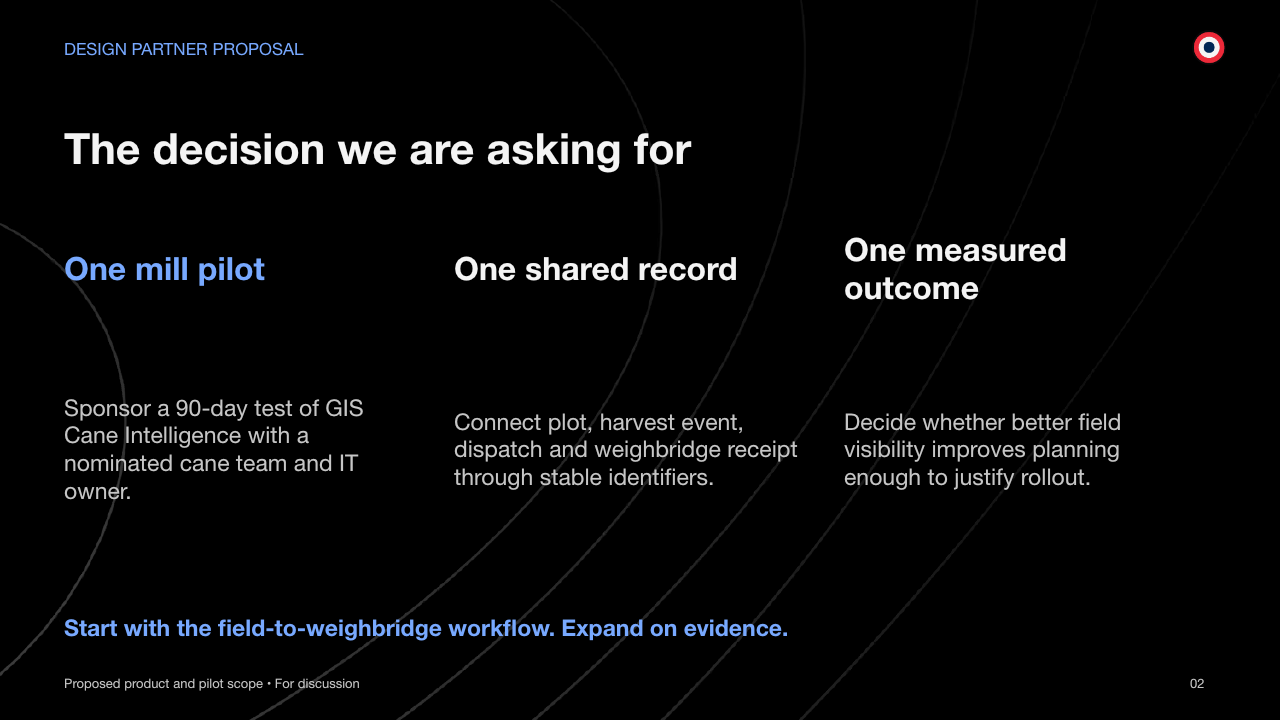
DESIGN PARTNER PROPOSAL The decision we are asking for Proposed product and pilot scope • For discussion 02 One mill pilot Sponsor a 90-day test of GIS Cane Intelligence with a nominated cane team and IT owner. One shared record Connect plot, harvest event, dispatch and weighbridge receipt through stable identifiers. One measured outcome Decide whether better field visibility improves planning enough to justify rollout. Start with the field-to-weighbridge workflow. Expand on evidence.02 / The decision we are asking for
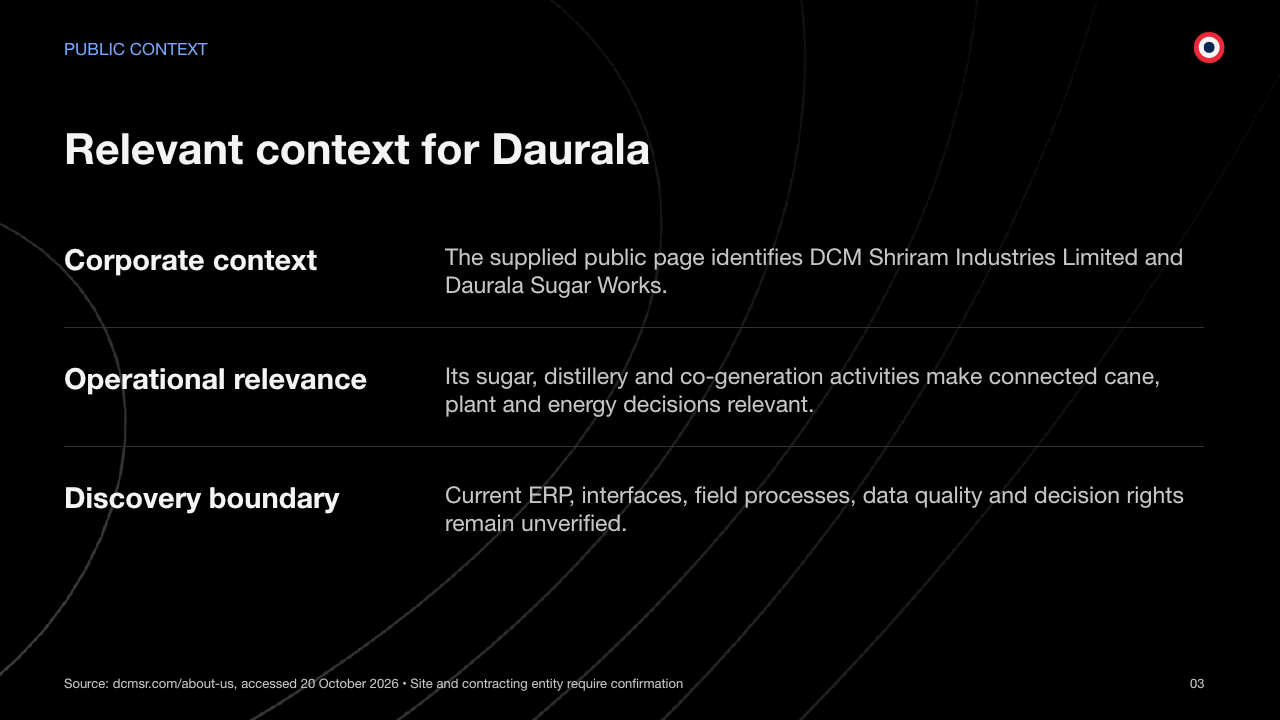
PUBLIC CONTEXT Relevant context for Daurala Source: dcmsr.com/about-us, accessed 20 October 2026 • Site and contracting entity require confirmation 03 Corporate context The supplied public page identifies DCM Shriram Industries Limited and Daurala Sugar Works. Operational relevance Its sugar, distillery and co-generation activities make connected cane, plant and energy decisions relevant. Discovery boundary Current ERP, interfaces, field processes, data quality and decision rights remain unverified.03 / Relevant context for Daurala
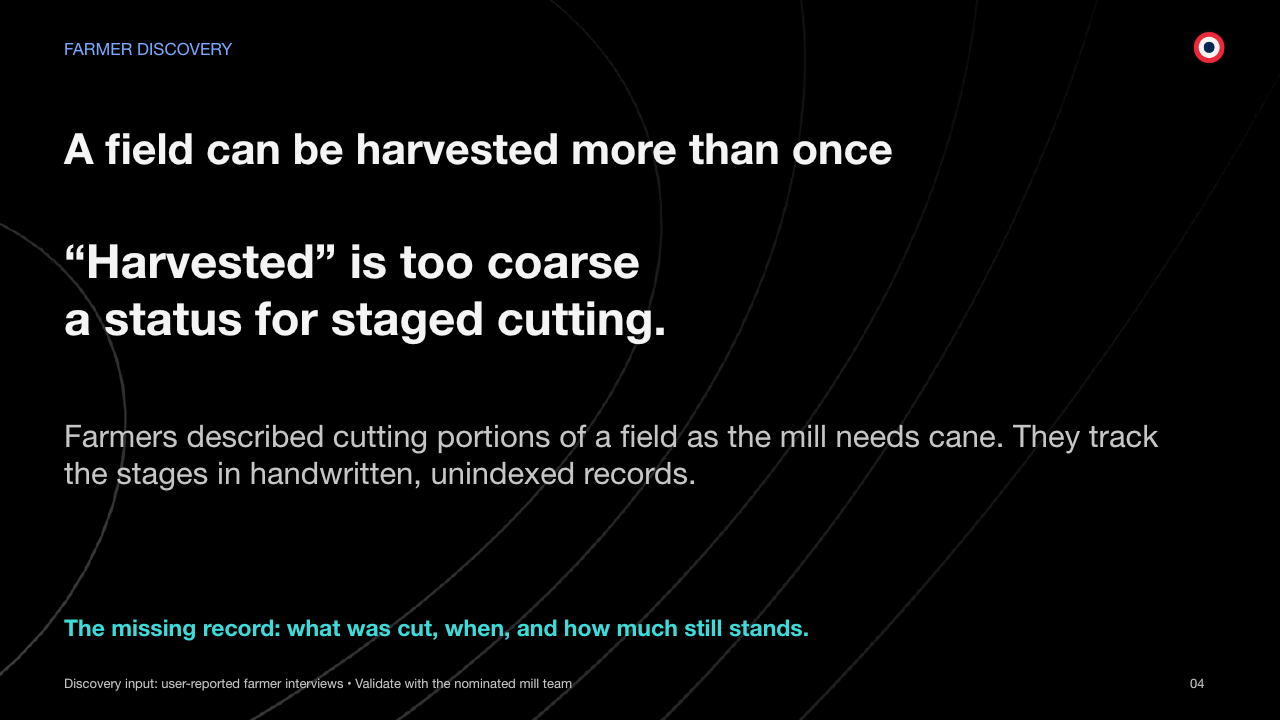
FARMER DISCOVERY A field can be harvested more than once Discovery input: user-reported farmer interviews • Validate with the nominated mill team 04 “Harvested” is too coarse a status for staged cutting. Farmers described cutting portions of a field as the mill needs cane. They track the stages in handwritten, unindexed records. The missing record: what was cut, when, and how much still stands.04 / A field can be harvested more than once
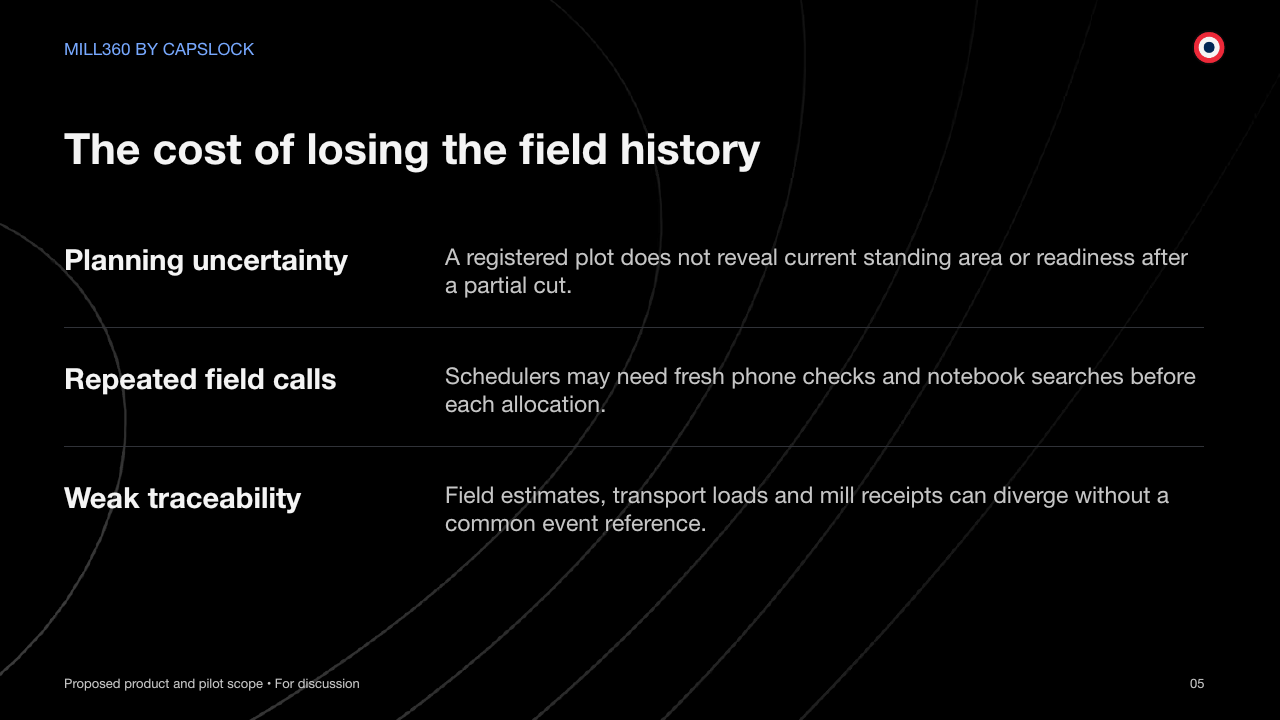
MILL360 BY CAPSLOCK The cost of losing the field history Proposed product and pilot scope • For discussion 05 Planning uncertainty A registered plot does not reveal current standing area or readiness after a partial cut. Repeated field calls Schedulers may need fresh phone checks and notebook searches before each allocation. Weak traceability Field estimates, transport loads and mill receipts can diverge without a common event reference.05 / The cost of losing the field history
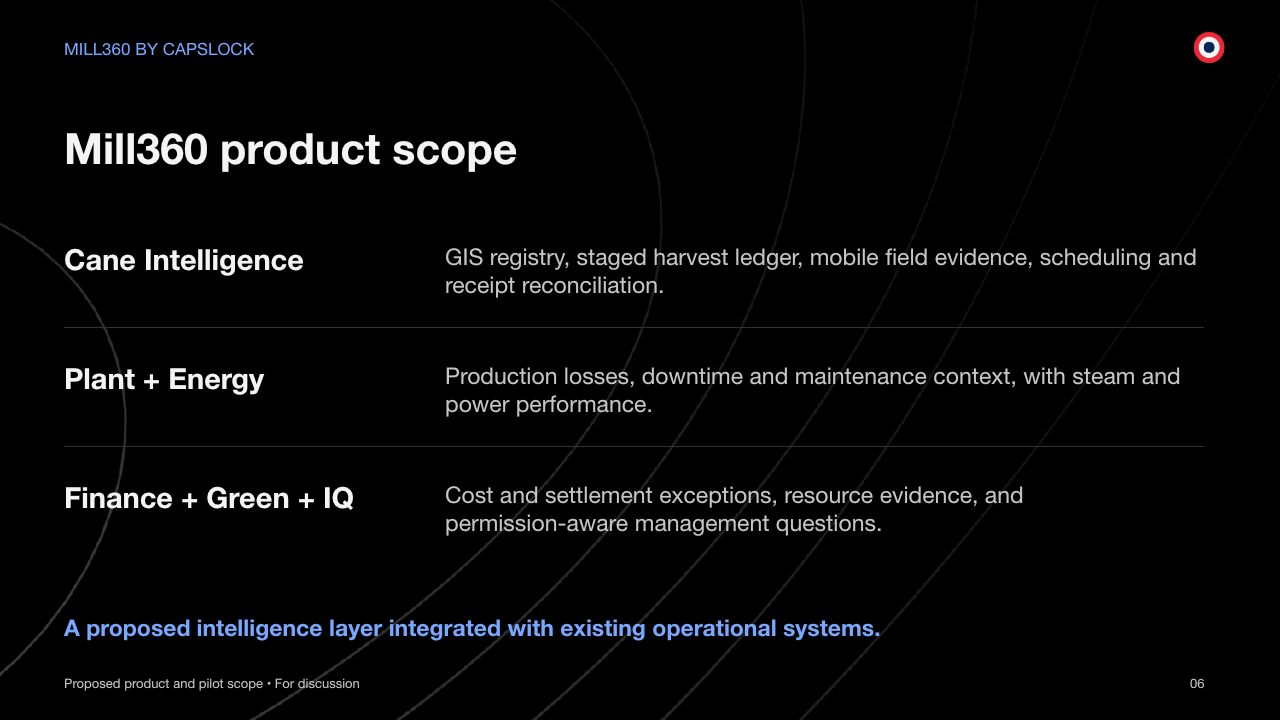
MILL360 BY CAPSLOCK Mill360 product scope Proposed product and pilot scope • For discussion 06 Cane Intelligence GIS registry, staged harvest ledger, mobile field evidence, scheduling and receipt reconciliation. Plant + Energy Production losses, downtime and maintenance context, with steam and power performance. Finance + Green + IQ Cost and settlement exceptions, resource evidence, and permission-aware management questions. A proposed intelligence layer integrated with existing operational systems.06 / Mill360 product scope
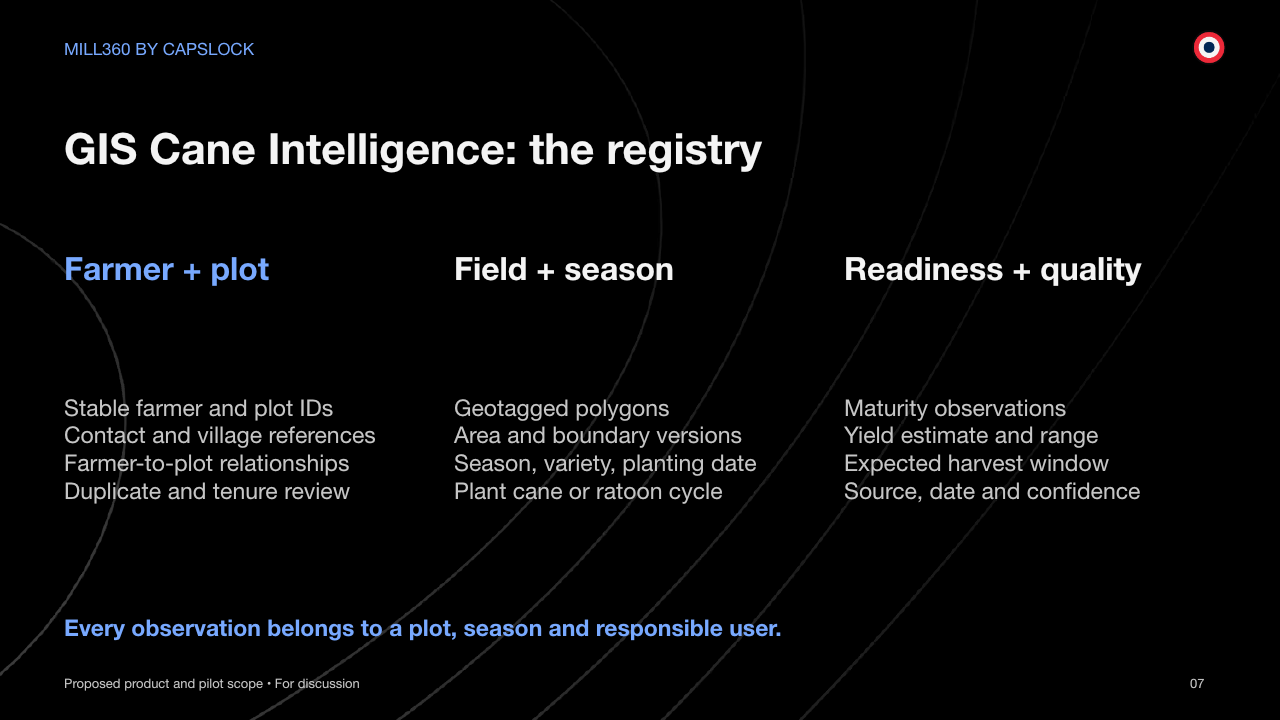
MILL360 BY CAPSLOCK GIS Cane Intelligence: the registry Proposed product and pilot scope • For discussion 07 Farmer + plot Stable farmer and plot IDs Contact and village references Farmer-to-plot relationships Duplicate and tenure review Field + season Geotagged polygons Area and boundary versions Season, variety, planting date Plant cane or ratoon cycle Readiness + quality Maturity observations Yield estimate and range Expected harvest window Source, date and confidence Every observation belongs to a plot, season and responsible user.07 / GIS Cane Intelligence: the registry
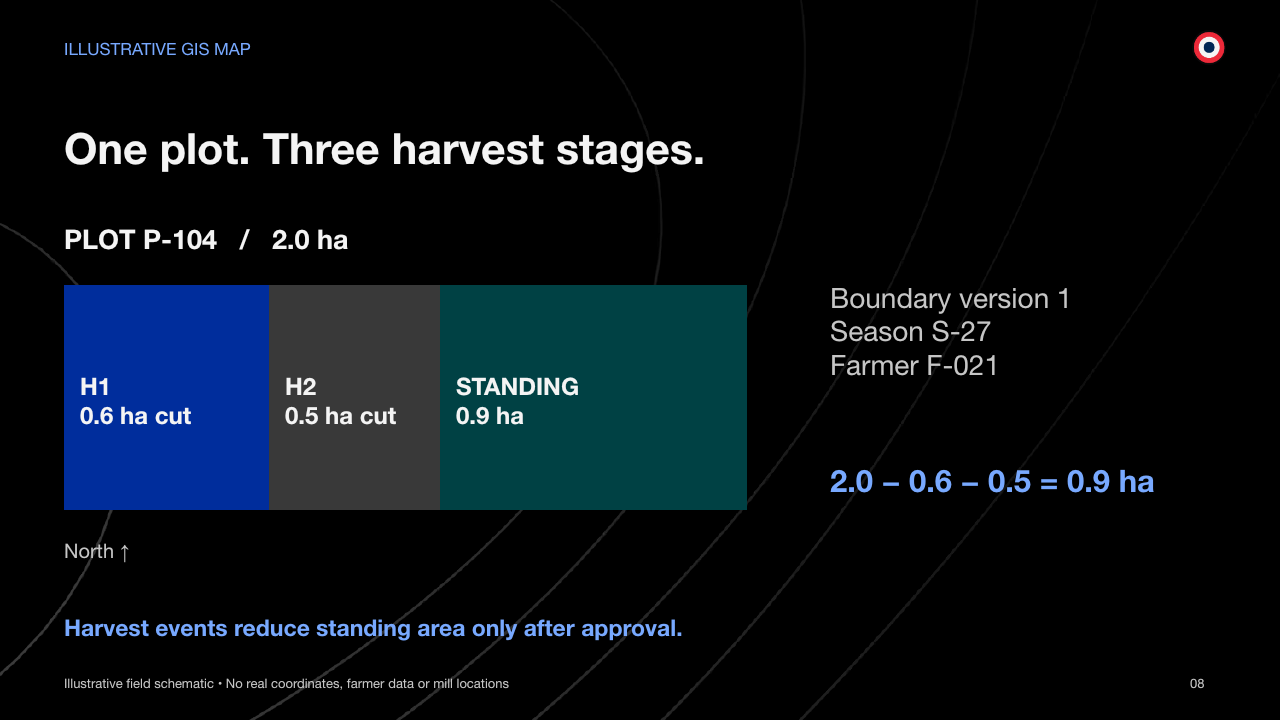
ILLUSTRATIVE GIS MAP One plot. Three harvest stages. Illustrative field schematic • No real coordinates, farmer data or mill locations 08 PLOT P-104   /   2.0 ha H1 0.6 ha cut H2 0.5 ha cut STANDING 0.9 ha North ↑ Boundary version 1 Season S-27 Farmer F-021 2.0 − 0.6 − 0.5 = 0.9 ha Harvest events reduce standing area only after approval.08 / One plot. Three harvest stages.
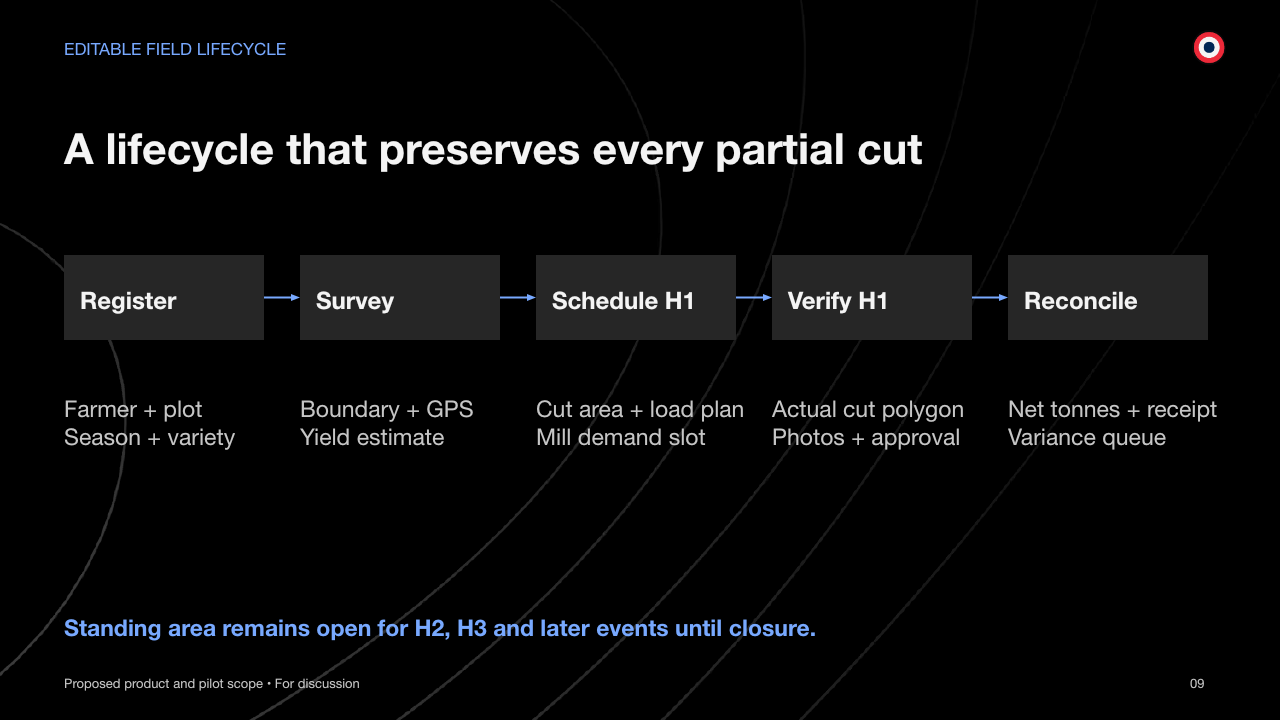
EDITABLE FIELD LIFECYCLE A lifecycle that preserves every partial cut Proposed product and pilot scope • For discussion 09 Register Survey Schedule H1 Verify H1 Reconcile Farmer + plot Season + variety Boundary + GPS Yield estimate Cut area + load plan Mill demand slot Actual cut polygon Photos + approval Net tonnes + receipt Variance queue Standing area remains open for H2, H3 and later events until closure.09 / A lifecycle that preserves every partial cut
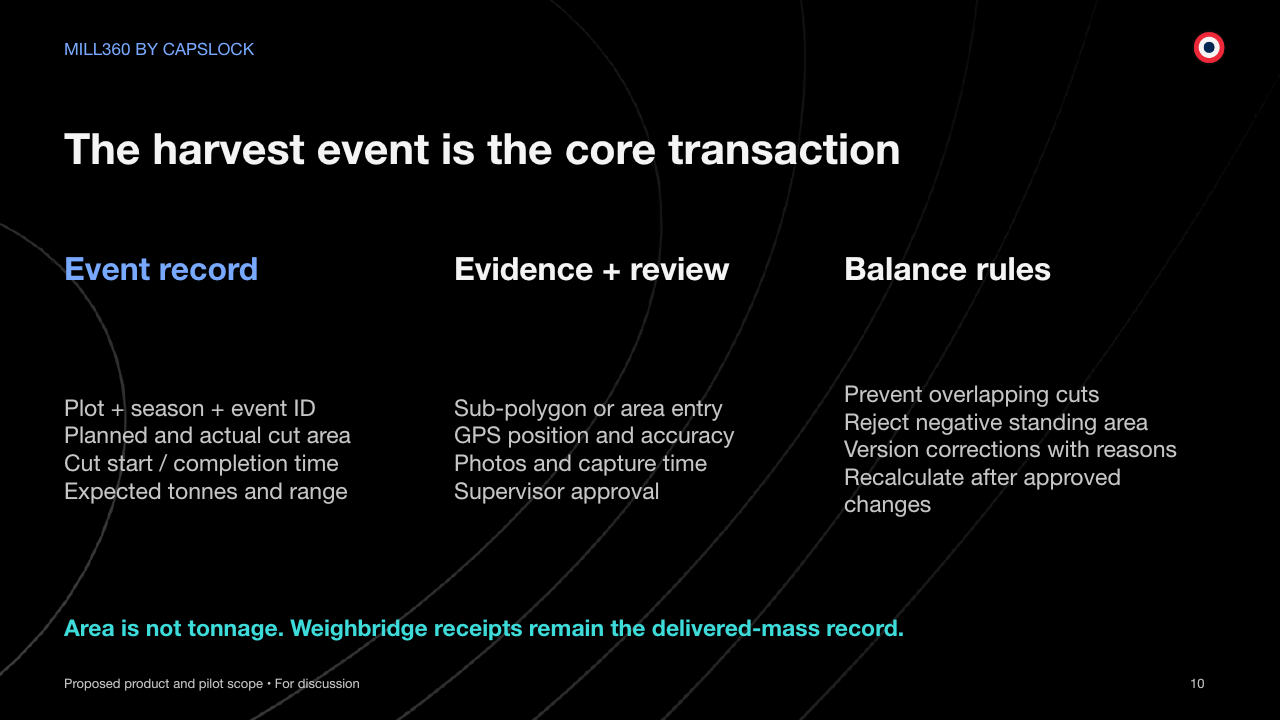
MILL360 BY CAPSLOCK The harvest event is the core transaction Proposed product and pilot scope • For discussion 10 Event record Plot + season + event ID Planned and actual cut area Cut start / completion time Expected tonnes and range Evidence + review Sub-polygon or area entry GPS position and accuracy Photos and capture time Supervisor approval Balance rules Prevent overlapping cuts Reject negative standing area Version corrections with reasons Recalculate after approved changes Area is not tonnage. Weighbridge receipts remain the delivered-mass record.10 / The harvest event is the core transaction
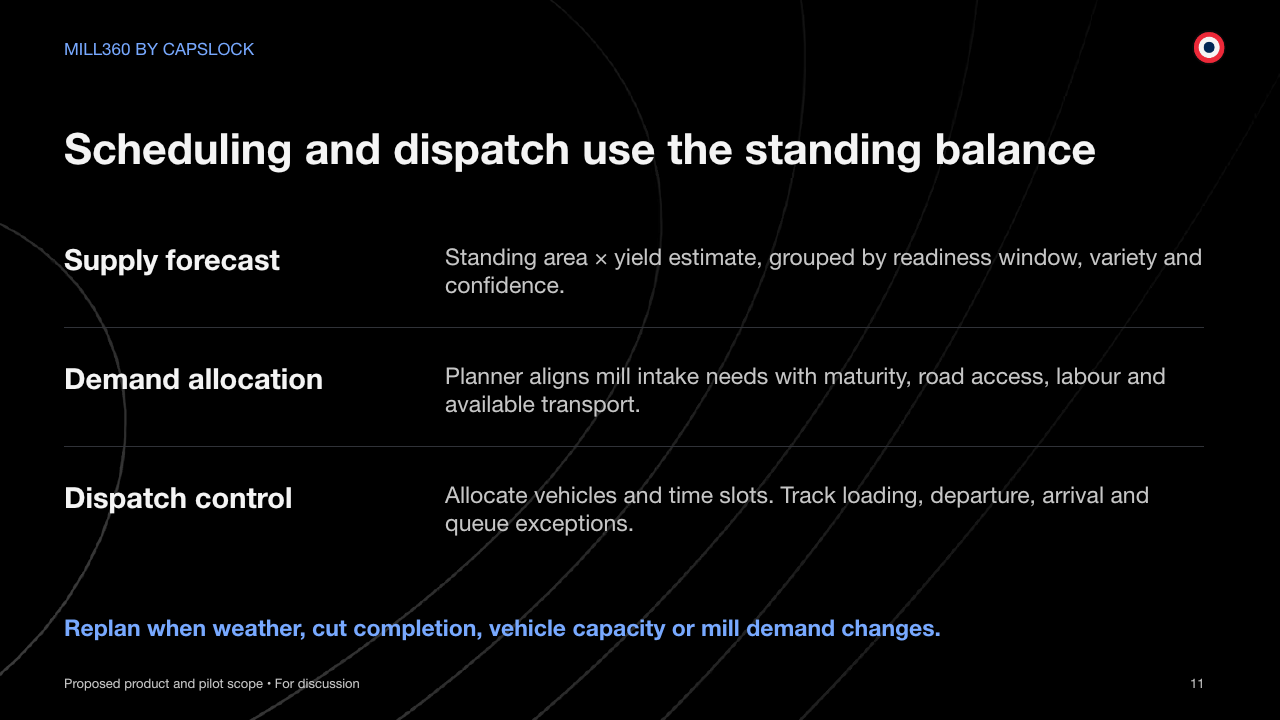
MILL360 BY CAPSLOCK Scheduling and dispatch use the standing balance Proposed product and pilot scope • For discussion 11 Supply forecast Standing area × yield estimate, grouped by readiness window, variety and confidence. Demand allocation Planner aligns mill intake needs with maturity, road access, labour and available transport. Dispatch control Allocate vehicles and time slots. Track loading, departure, arrival and queue exceptions. Replan when weather, cut completion, vehicle capacity or mill demand changes.11 / Scheduling and dispatch use the standing balance
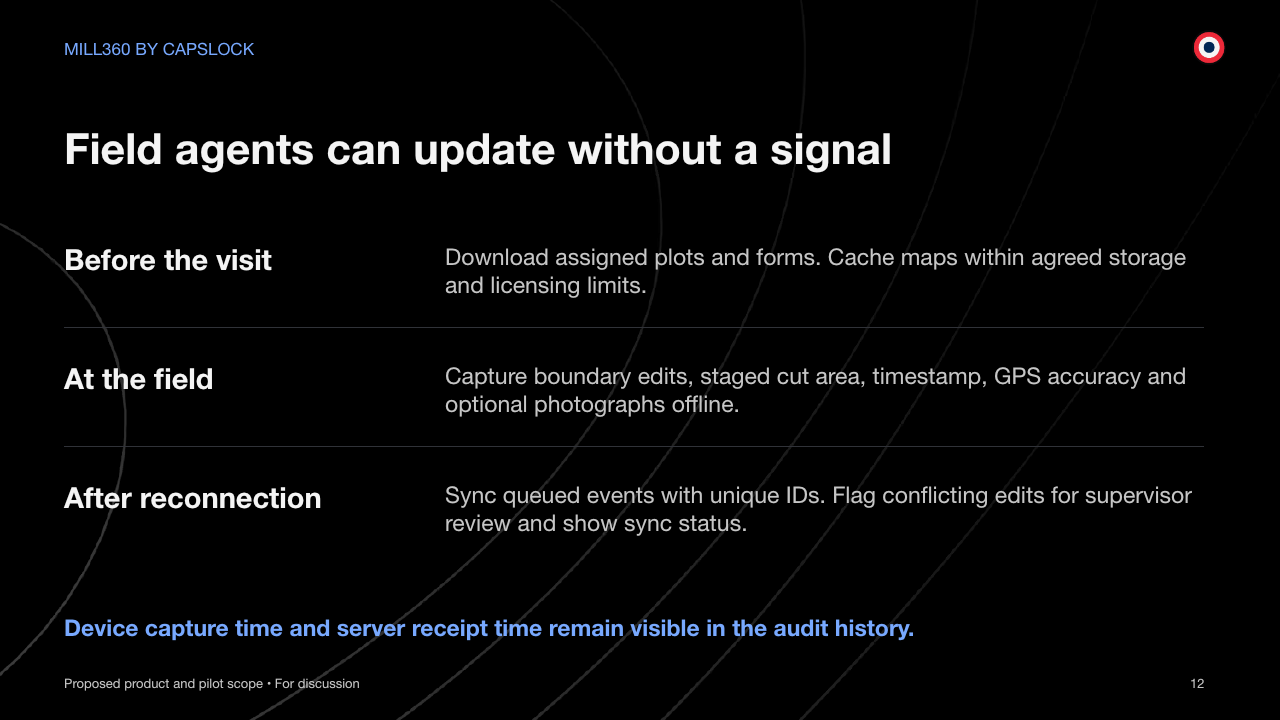
MILL360 BY CAPSLOCK Field agents can update without a signal Proposed product and pilot scope • For discussion 12 Before the visit Download assigned plots and forms. Cache maps within agreed storage and licensing limits. At the field Capture boundary edits, staged cut area, timestamp, GPS accuracy and optional photographs offline. After reconnection Sync queued events with unique IDs. Flag conflicting edits for supervisor review and show sync status. Device capture time and server receipt time remain visible in the audit history.12 / Field agents can update without a signal
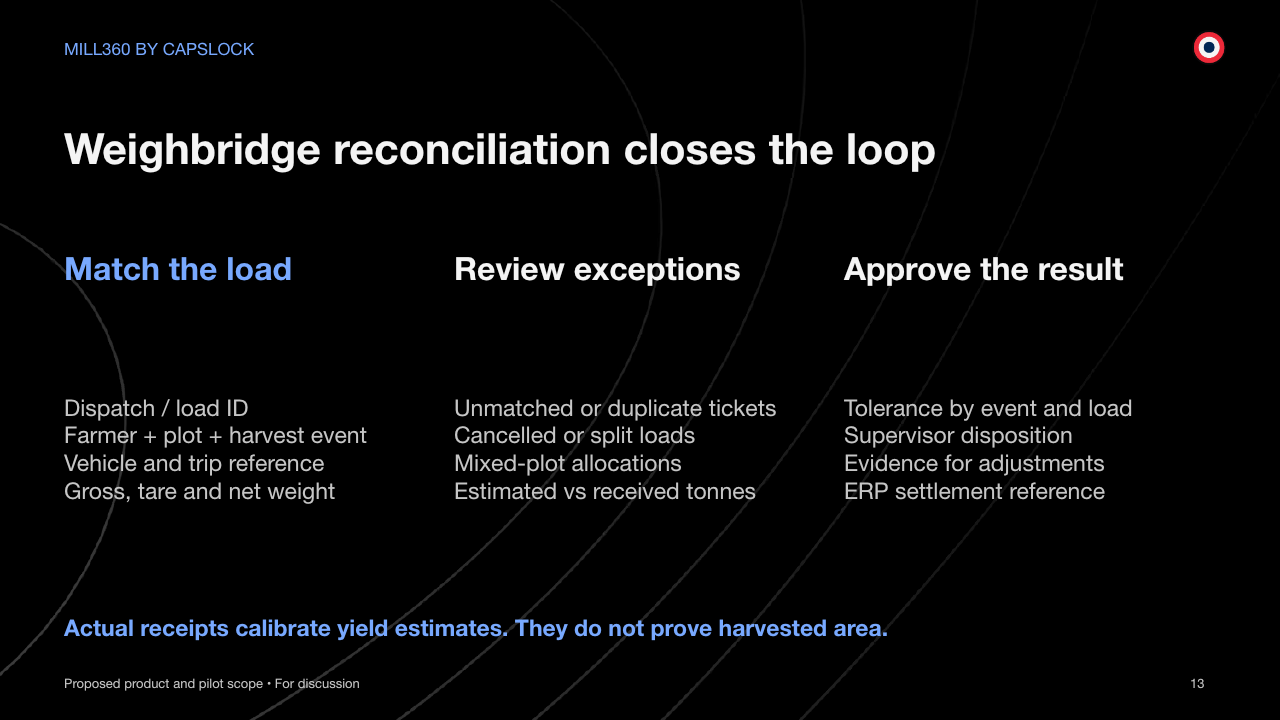
MILL360 BY CAPSLOCK Weighbridge reconciliation closes the loop Proposed product and pilot scope • For discussion 13 Match the load Dispatch / load ID Farmer + plot + harvest event Vehicle and trip reference Gross, tare and net weight Review exceptions Unmatched or duplicate tickets Cancelled or split loads Mixed-plot allocations Estimated vs received tonnes Approve the result Tolerance by event and load Supervisor disposition Evidence for adjustments ERP settlement reference Actual receipts calibrate yield estimates. They do not prove harvested area.13 / Weighbridge reconciliation closes the loop
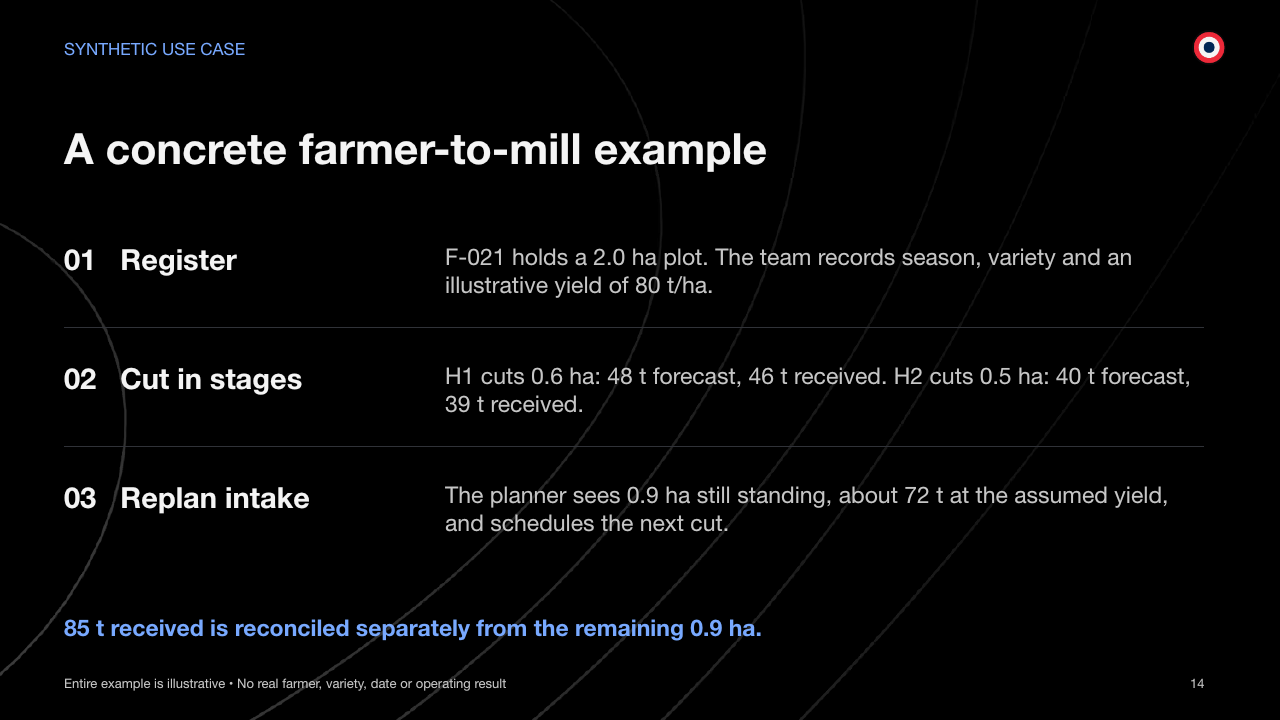
SYNTHETIC USE CASE A concrete farmer-to-mill example Entire example is illustrative • No real farmer, variety, date or operating result 14 01   Register F-021 holds a 2.0 ha plot. The team records season, variety and an illustrative yield of 80 t/ha. 02   Cut in stages H1 cuts 0.6 ha: 48 t forecast, 46 t received. H2 cuts 0.5 ha: 40 t forecast, 39 t received. 03   Replan intake The planner sees 0.9 ha still standing, about 72 t at the assumed yield, and schedules the next cut. 85 t received is reconciled separately from the remaining 0.9 ha.14 / A concrete farmer-to-mill example
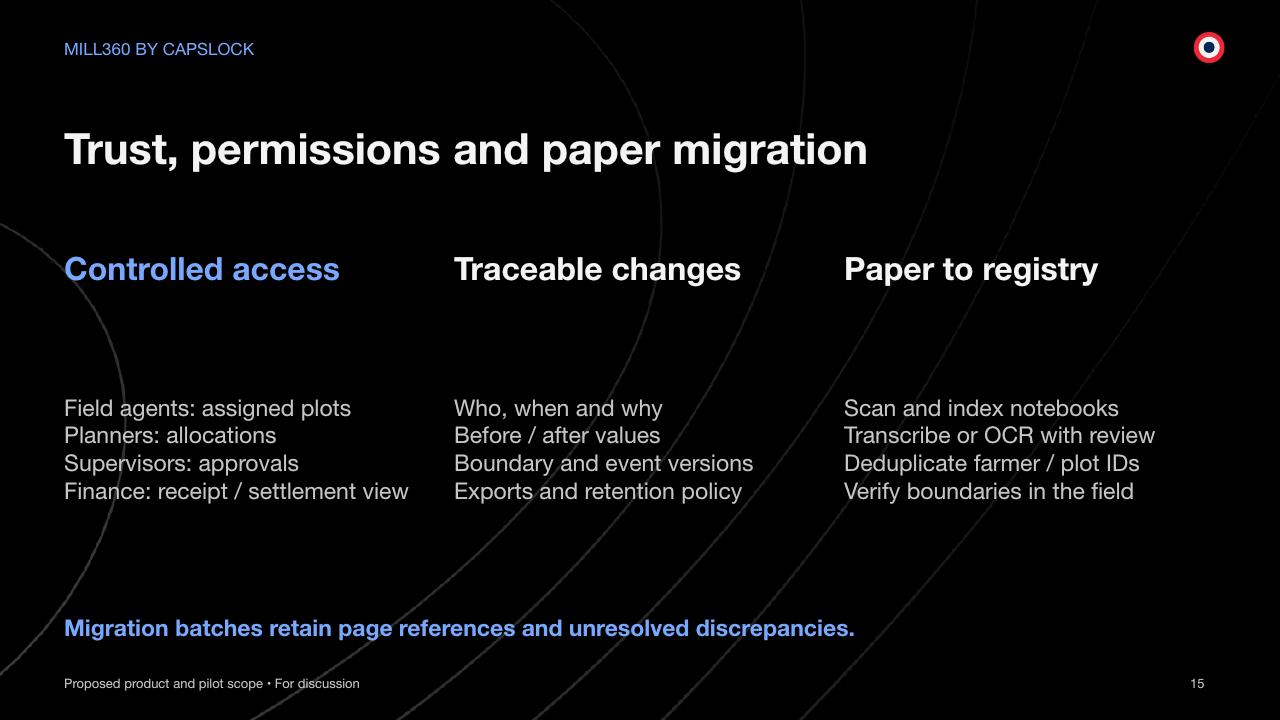
MILL360 BY CAPSLOCK Trust, permissions and paper migration Proposed product and pilot scope • For discussion 15 Controlled access Field agents: assigned plots Planners: allocations Supervisors: approvals Finance: receipt / settlement view Traceable changes Who, when and why Before / after values Boundary and event versions Exports and retention policy Paper to registry Scan and index notebooks Transcribe or OCR with review Deduplicate farmer / plot IDs Verify boundaries in the field Migration batches retain page references and unresolved discrepancies.15 / Trust, permissions and paper migration
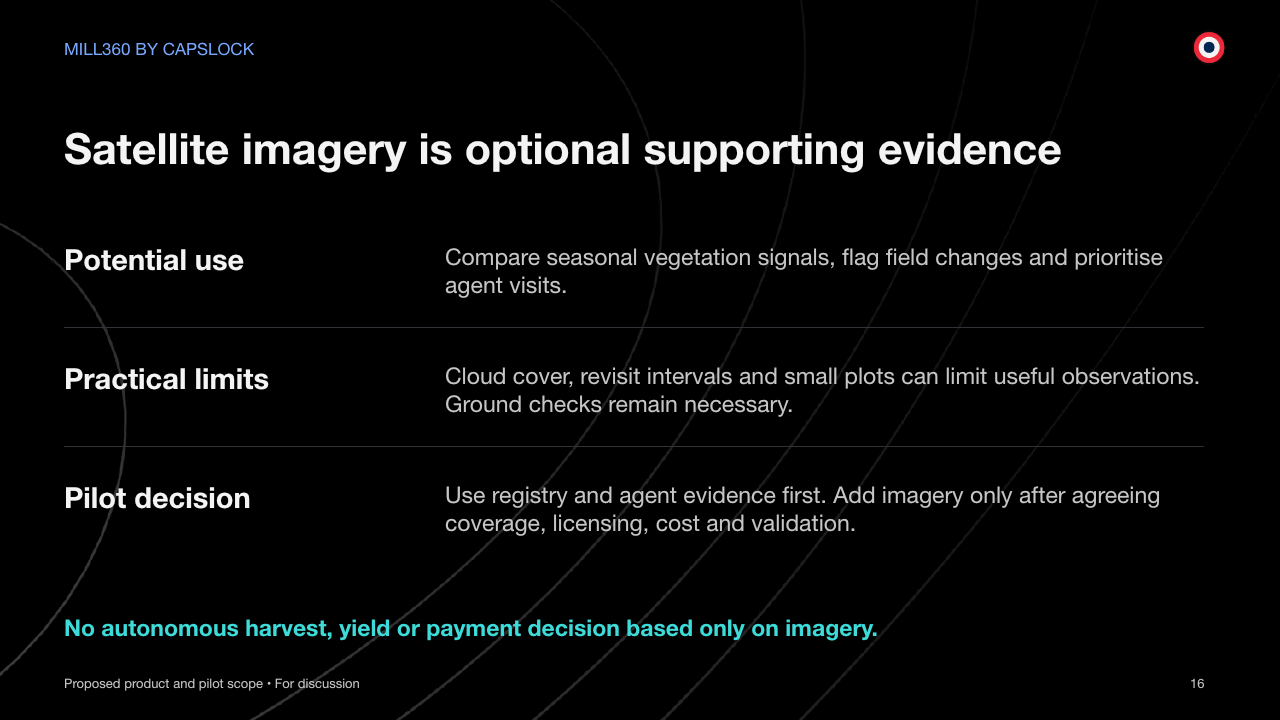
MILL360 BY CAPSLOCK Satellite imagery is optional supporting evidence Proposed product and pilot scope • For discussion 16 Potential use Compare seasonal vegetation signals, flag field changes and prioritise agent visits. Practical limits Cloud cover, revisit intervals and small plots can limit useful observations. Ground checks remain necessary. Pilot decision Use registry and agent evidence first. Add imagery only after agreeing coverage, licensing, cost and validation. No autonomous harvest, yield or payment decision based only on imagery.16 / Satellite imagery is optional supporting evidence
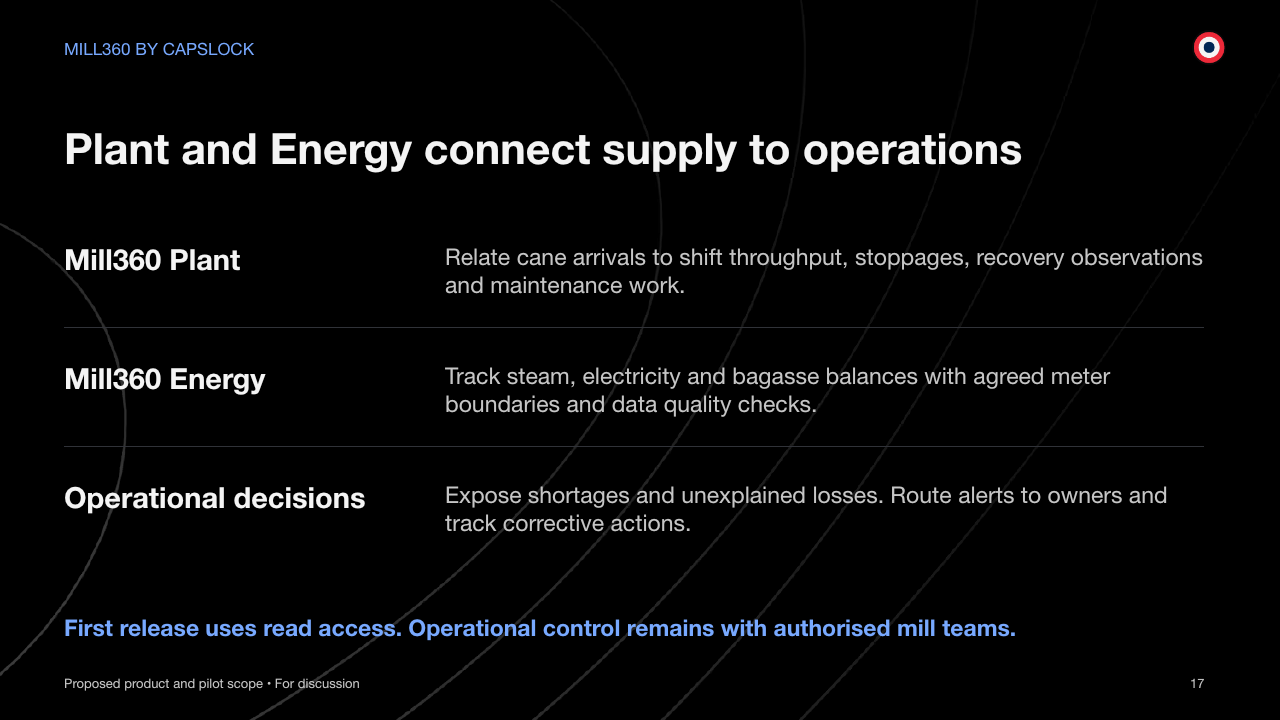
MILL360 BY CAPSLOCK Plant and Energy connect supply to operations Proposed product and pilot scope • For discussion 17 Mill360 Plant Relate cane arrivals to shift throughput, stoppages, recovery observations and maintenance work. Mill360 Energy Track steam, electricity and bagasse balances with agreed meter boundaries and data quality checks. Operational decisions Expose shortages and unexplained losses. Route alerts to owners and track corrective actions. First release uses read access. Operational control remains with authorised mill teams.17 / Plant and Energy connect supply to operations
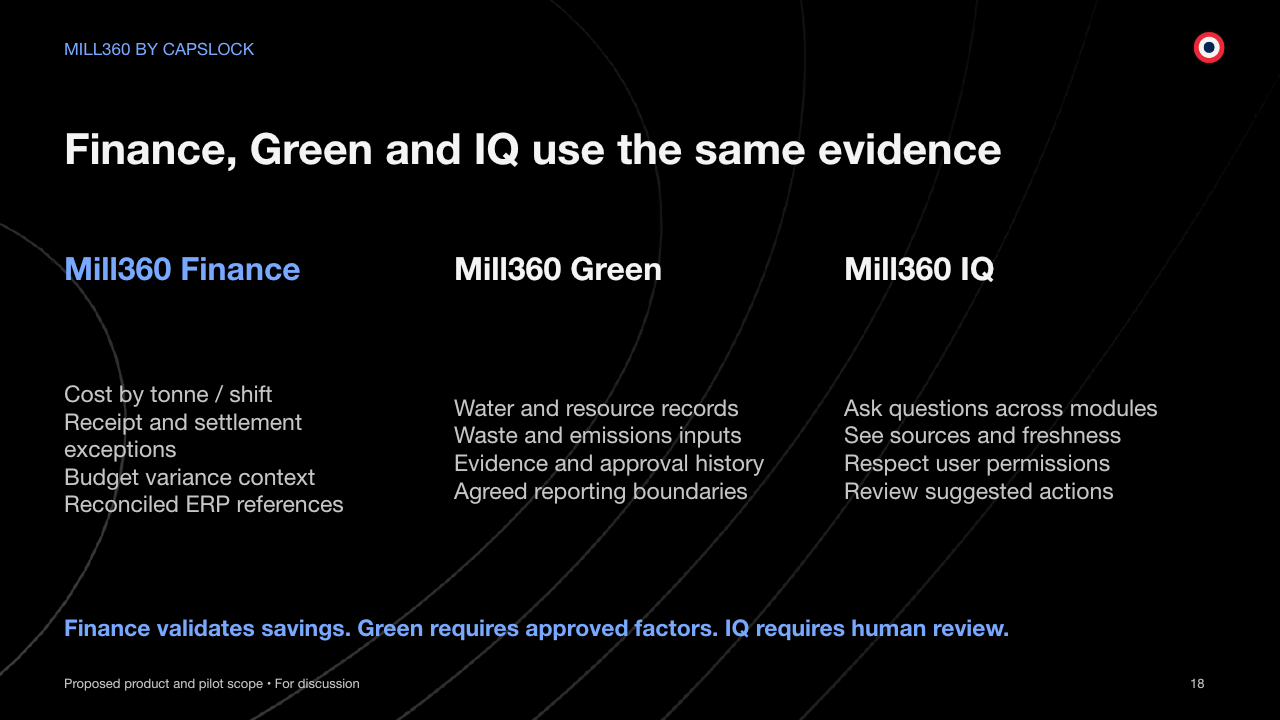
MILL360 BY CAPSLOCK Finance, Green and IQ use the same evidence Proposed product and pilot scope • For discussion 18 Mill360 Finance Cost by tonne / shift Receipt and settlement exceptions Budget variance context Reconciled ERP references Mill360 Green Water and resource records Waste and emissions inputs Evidence and approval history Agreed reporting boundaries Mill360 IQ Ask questions across modules See sources and freshness Respect user permissions Review suggested actions Finance validates savings. Green requires approved factors. IQ requires human review.18 / Finance, Green and IQ use the same evidence
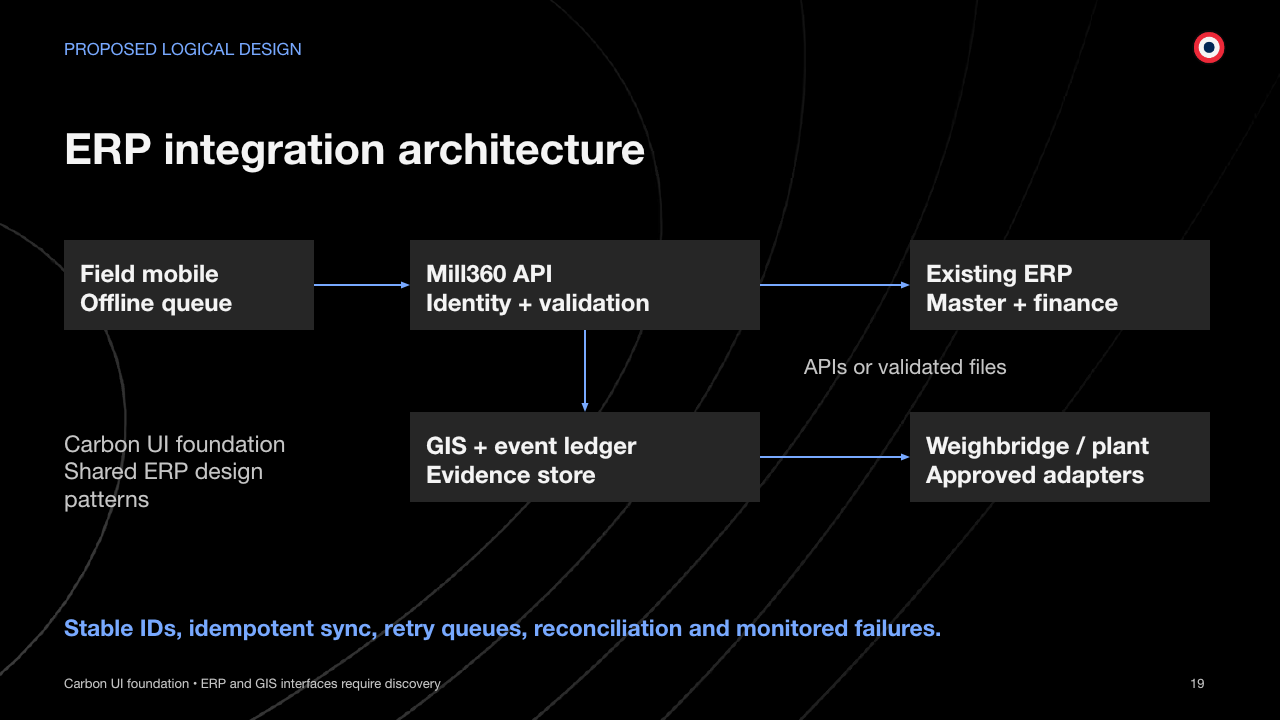
PROPOSED LOGICAL DESIGN ERP integration architecture Carbon UI foundation • ERP and GIS interfaces require discovery 19 Field mobile Offline queue Mill360 API Identity + validation Existing ERP Master + finance GIS + event ledger Evidence store Weighbridge / plant Approved adapters Carbon UI foundation Shared ERP design patterns APIs or validated files Stable IDs, idempotent sync, retry queues, reconciliation and monitored failures.19 / ERP integration architecture
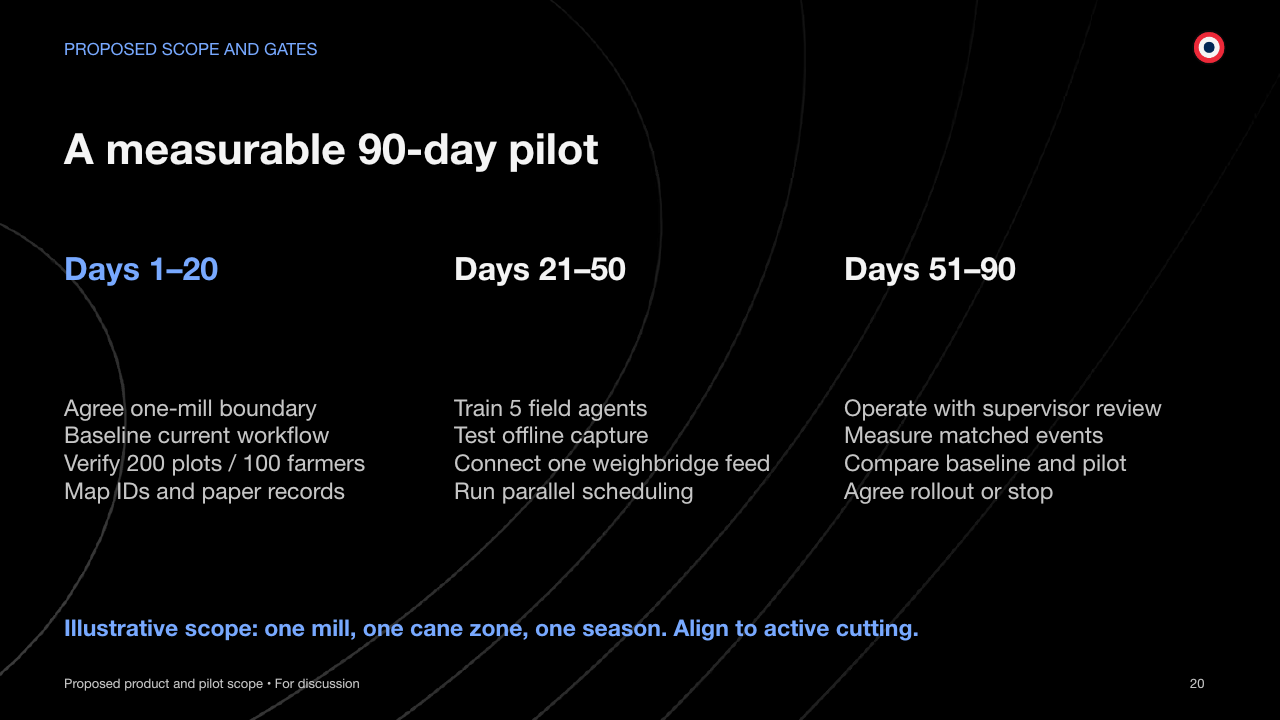
PROPOSED SCOPE AND GATES A measurable 90-day pilot Proposed product and pilot scope • For discussion 20 Days 1–20 Agree one-mill boundary Baseline current workflow Verify 200 plots / 100 farmers Map IDs and paper records Days 21–50 Train 5 field agents Test offline capture Connect one weighbridge feed Run parallel scheduling Days 51–90 Operate with supervisor review Measure matched events Compare baseline and pilot Agree rollout or stop Illustrative scope: one mill, one cane zone, one season. Align to active cutting.20 / A measurable 90-day pilot
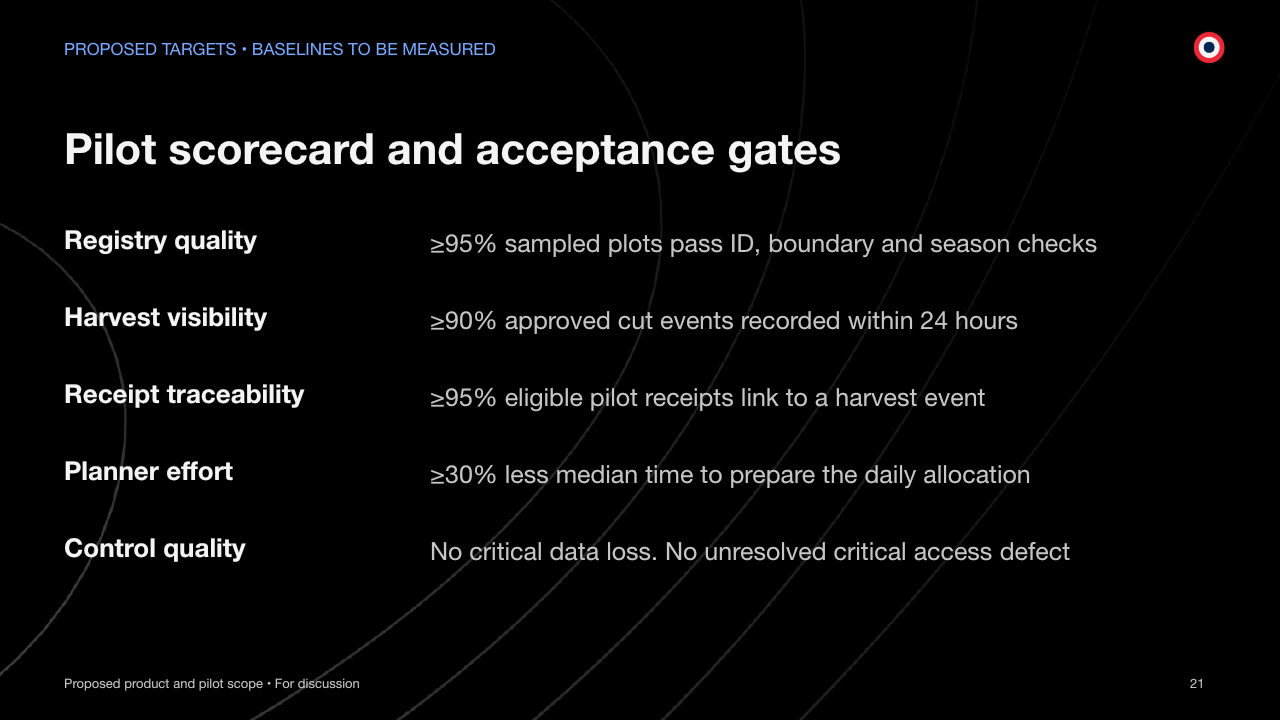
PROPOSED TARGETS • BASELINES TO BE MEASURED Pilot scorecard and acceptance gates Proposed product and pilot scope • For discussion 21 Registry quality ≥95% sampled plots pass ID, boundary and season checks Harvest visibility ≥90% approved cut events recorded within 24 hours Receipt traceability ≥95% eligible pilot receipts link to a harvest event Planner effort ≥30% less median time to prepare the daily allocation Control quality No critical data loss. No unresolved critical access defect21 / Pilot scorecard and acceptance gates
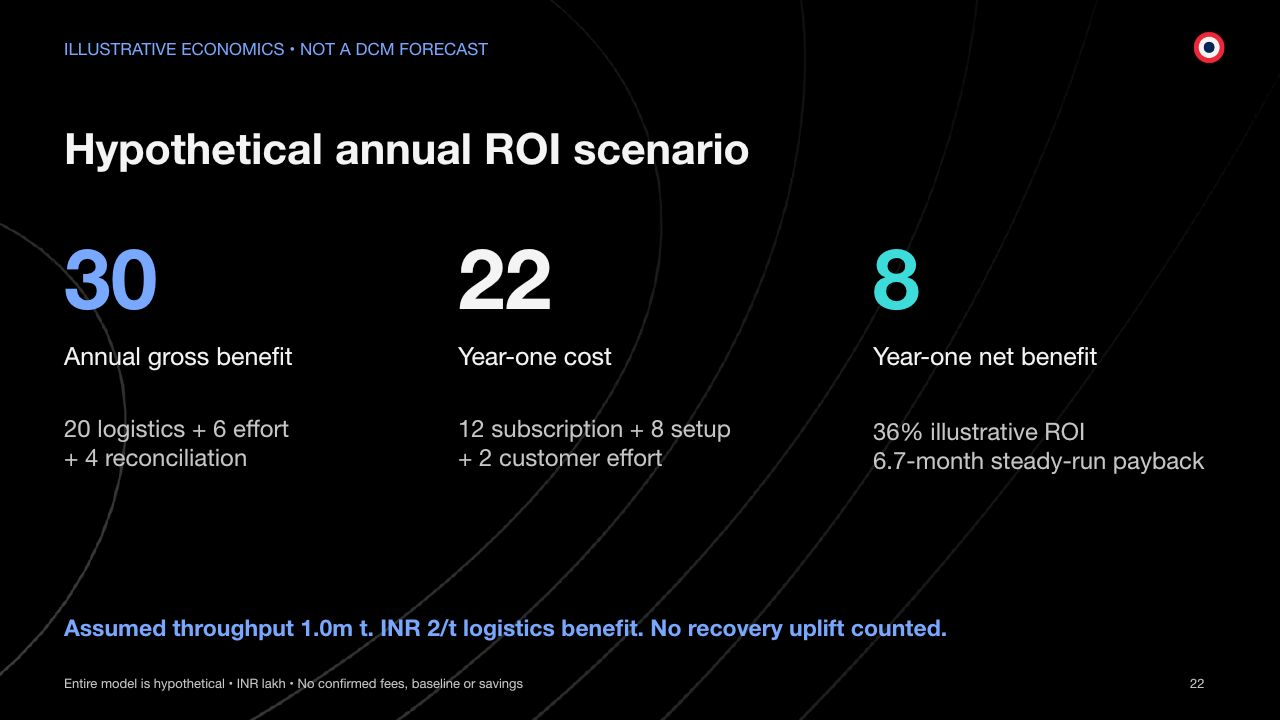
ILLUSTRATIVE ECONOMICS • NOT A DCM FORECAST Hypothetical annual ROI scenario Entire model is hypothetical • INR lakh • No confirmed fees, baseline or savings 22 30 Annual gross benefit 20 logistics + 6 effort + 4 reconciliation 22 Year-one cost 12 subscription + 8 setup + 2 customer effort 8 Year-one net benefit 36% illustrative ROI 6.7-month steady-run payback Assumed throughput 1.0m t. INR 2/t logistics benefit. No recovery uplift counted.22 / Hypothetical annual ROI scenario
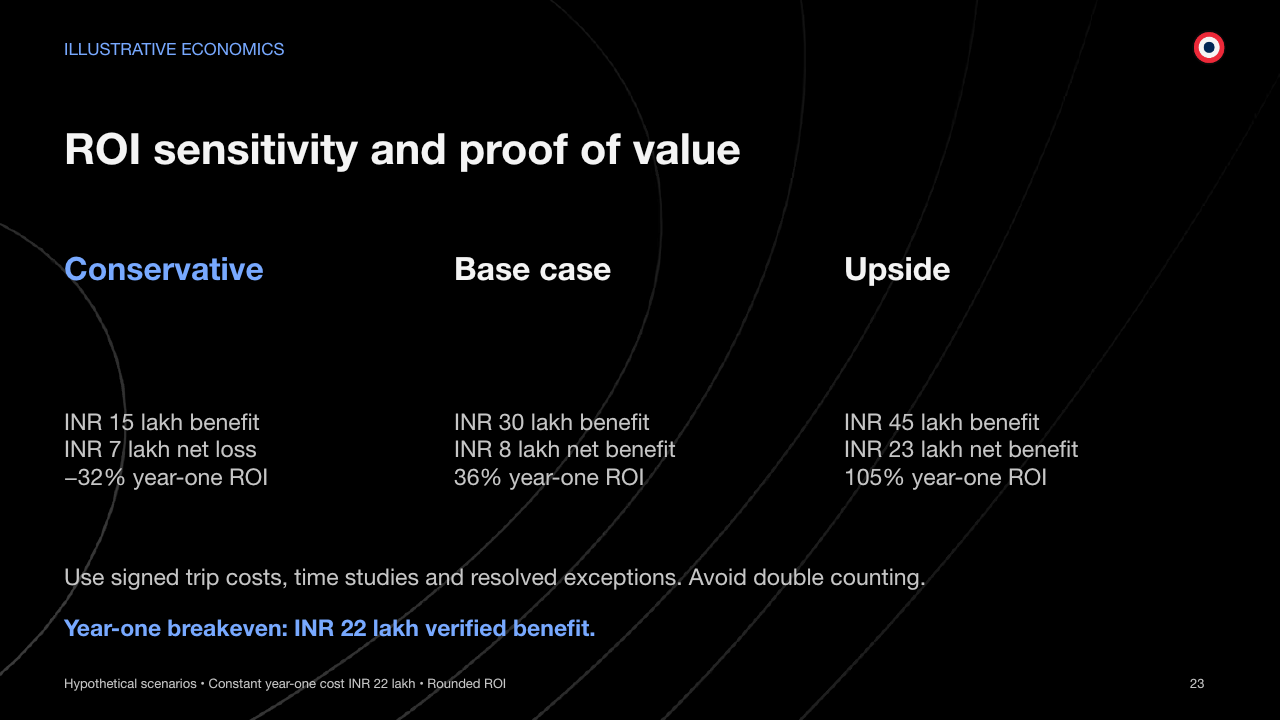
ILLUSTRATIVE ECONOMICS ROI sensitivity and proof of value Hypothetical scenarios • Constant year-one cost INR 22 lakh • Rounded ROI 23 Conservative INR 15 lakh benefit INR 7 lakh net loss −32% year-one ROI Base case INR 30 lakh benefit INR 8 lakh net benefit 36% year-one ROI Upside INR 45 lakh benefit INR 23 lakh net benefit 105% year-one ROI Year-one breakeven: INR 22 lakh verified benefit. Use signed trip costs, time studies and resolved exceptions. Avoid double counting.23 / ROI sensitivity and proof of value
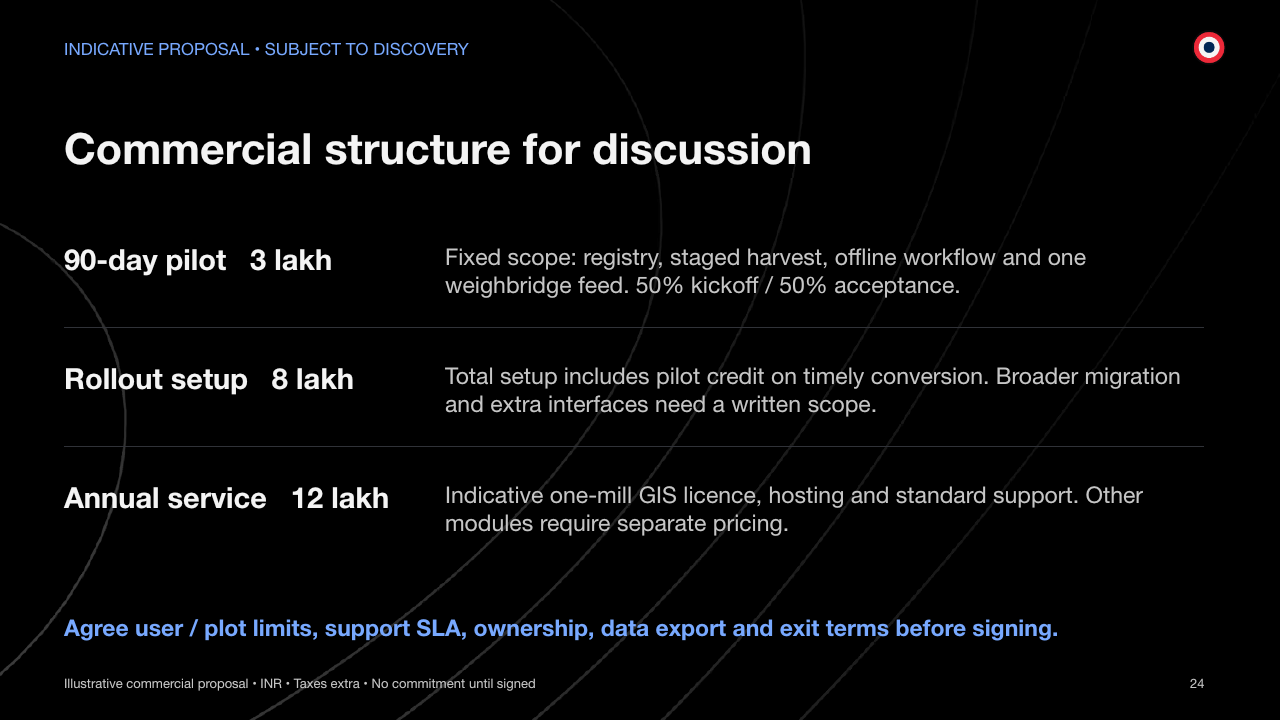
INDICATIVE PROPOSAL • SUBJECT TO DISCOVERY Commercial structure for discussion Illustrative commercial proposal • INR • Taxes extra • No commitment until signed 24 90-day pilot   3 lakh Fixed scope: registry, staged harvest, offline workflow and one weighbridge feed. 50% kickoff / 50% acceptance. Rollout setup   8 lakh Total setup includes pilot credit on timely conversion. Broader migration and extra interfaces need a written scope. Annual service   12 lakh Indicative one-mill GIS licence, hosting and standard support. Other modules require separate pricing. Agree user / plot limits, support SLA, ownership, data export and exit terms before signing.24 / Commercial structure for discussion
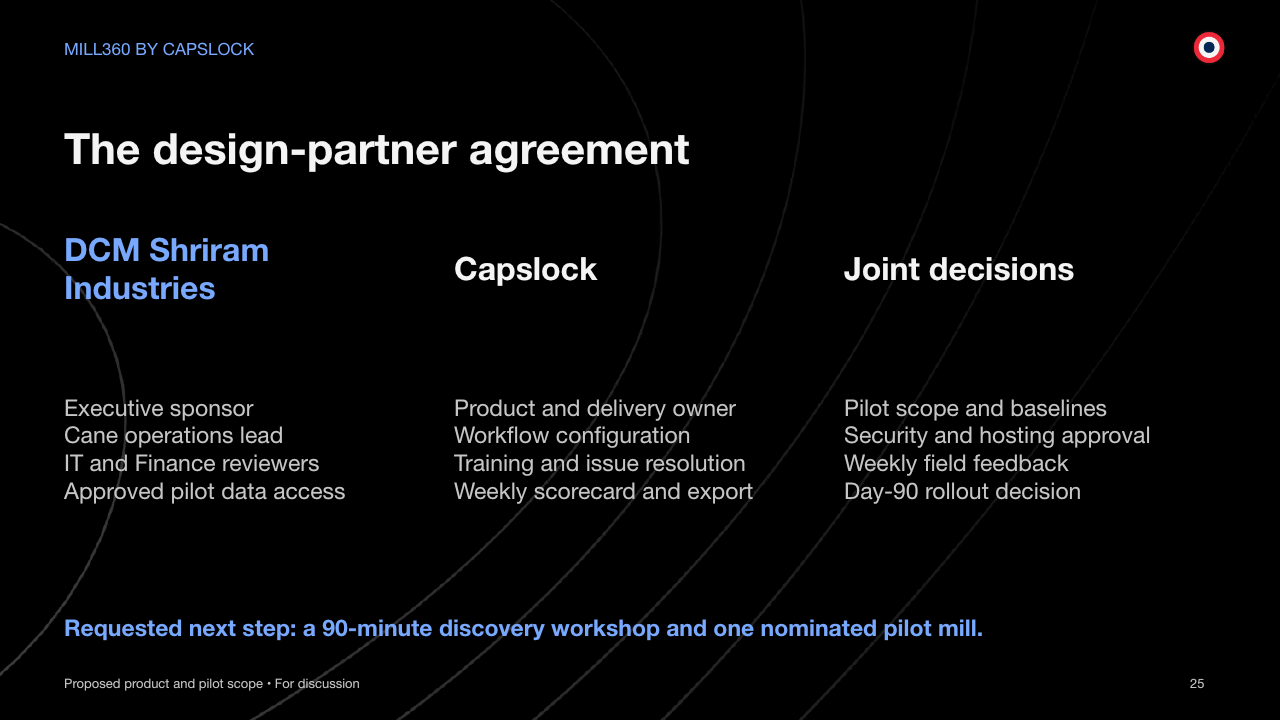
MILL360 BY CAPSLOCK The design-partner agreement Proposed product and pilot scope • For discussion 25 DCM Shriram Industries Executive sponsor Cane operations lead IT and Finance reviewers Approved pilot data access Capslock Product and delivery owner Workflow configuration Training and issue resolution Weekly scorecard and export Joint decisions Pilot scope and baselines Security and hosting approval Weekly field feedback Day-90 rollout decision Requested next step: a 90-minute discovery workshop and one nominated pilot mill.25 / The design-partner agreement
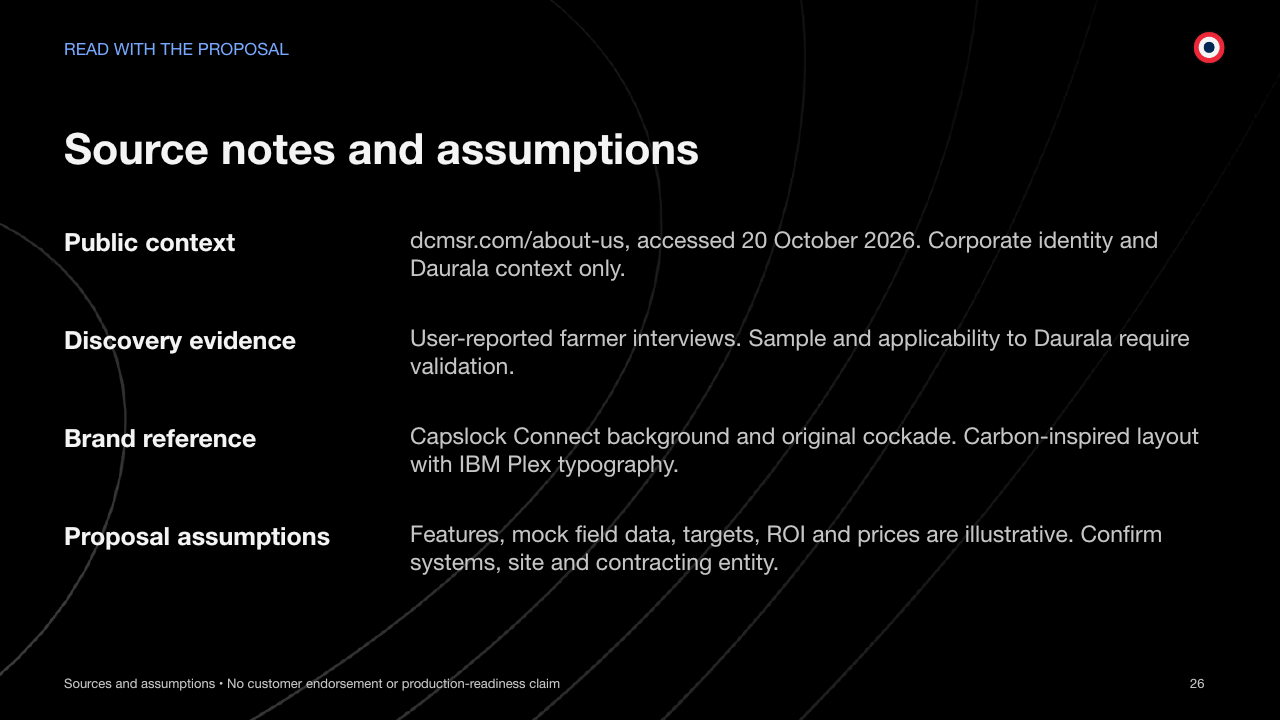
READ WITH THE PROPOSAL Source notes and assumptions Sources and assumptions • No customer endorsement or production-readiness claim 26 Public context dcmsr.com/about-us, accessed 20 October 2026. Corporate identity and Daurala context only. Discovery evidence User-reported farmer interviews. Sample and applicability to Daurala require validation. Brand reference Capslock Connect background and original cockade. Carbon-inspired layout with IBM Plex typography. Proposal assumptions Features, mock field data, targets, ROI and prices are illustrative. Confirm systems, site and contracting entity.26 / Source notes and assumptions
01 / 26
← → Navigate · F to present · Esc to exit
Sources, assumptions and slide notes